The November 2022 release of ChatGPT sent shockwaves through every industry, including the built environment. Everyone could easily see for themselves just how powerful generative artificial intelligence (AI) had become. And if AI developers’ predictions about scaling laws are correct, AI will become exponentially more capable not in the next decade, but just the next couple of years.
In Architecture, Engineering and Construction (AEC) specifically, AI may catalyze a wave of innovation for an industry whose tools have not changed much over the last decade. CAD, for example, emerged four decades ago. Revit introduced BIM 20 years ago, and while BIM did begin taking advantage of the cloud in the last decade to create Connected BIM, as Nicolas Mangon, VP AEC Strategy at Autodesk, notes, “Nothing much has changed in the last decade.”
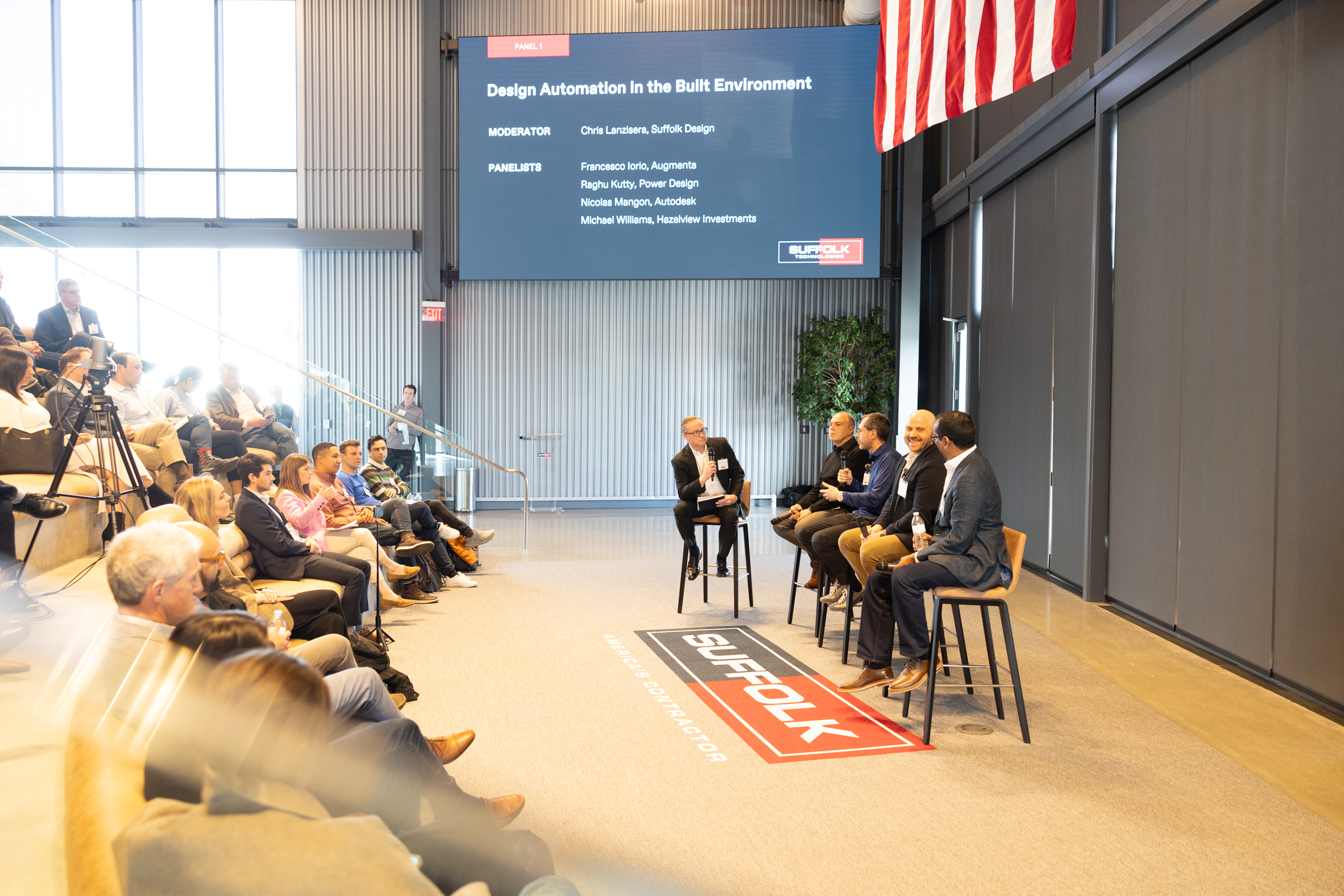
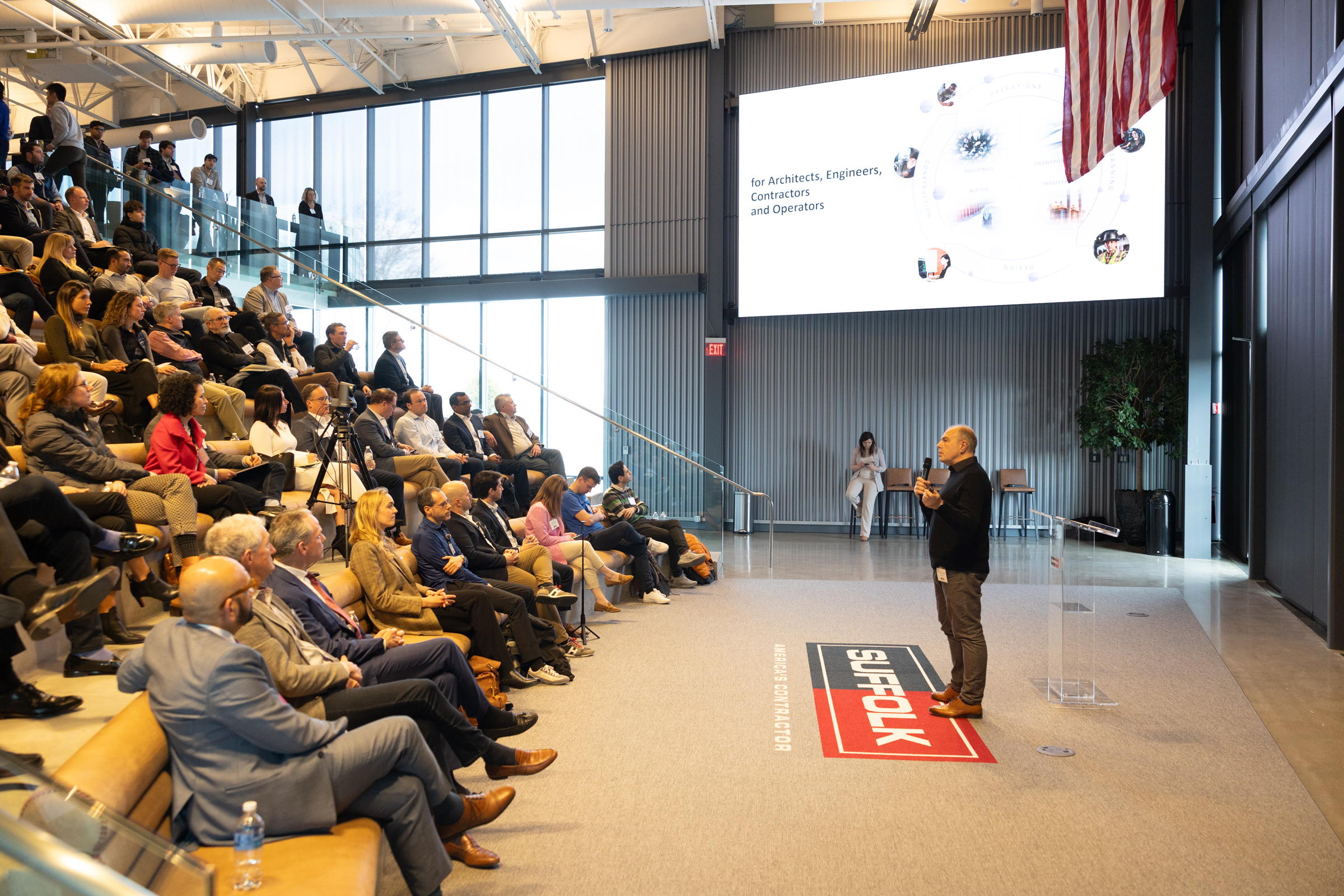
Mangon was one of the speakers and panelists at a half-day summit that Suffolk Technologies recently hosted titled: AI + Design in the Built Environment. This event brought together thought leaders from established tech companies and startups working at the edge of AI to have a real discussion alongside industry practitioners, from developers and owners to engineers, architects, and builders about the key challenges of AI adoption for design and construction. The stacked panels discussed the bottlenecks in the status quo, current applications of AI in AEC, and requirements to enable AI.
The problem with the AEC status quo
The increasing cost of design and construction is a huge challenge. For instance, the costs of designing, obtaining permits, and constructing new buildings have grown to the point that it’s becoming more common for projects to cost more than they are worth. These projects are also rife with delay. More than 1 in 5 (22.7%) projects are delivered more than 250 days late, and more than 1 in 8 (13.4%) are delayed by at least a year.
Part of the problem is that much of the design process is manual and repetitive. When designers themselves make mistakes, they’re hard to catch and fix. And when any of the various parties involved in designing a building makes changes to plans, those changes don’t always cascade down to the final plans in the builders’ hands. These changes can in turn cause errors and misunderstandings that require costly, time-consuming rework.
Another issue is the lack of shared information among the many parties that must collaborate to design and build a new building. There is a strong incentive to successfully complete the project, but not to share analytical data on projects over time. People, companies, and teams come together for two to three years and then never work in the same framework again. After all, while collaborators are giving it their all for years to deliver a building, once it’s done, they might be competitors on a future bid. It’s not that these companies don’t want to play nice and share, but the project-based nature of construction disincentivizes data sharing.
Additionally, even when the various parties do want to share data, doing so is very difficult, due to incompatible systems and lack of data standards. The files that need to be shared across parties are also typically very large, further encumbering shareability and collaboration. Dashboards such as Power BI have helped the industry get more transparency, but that’s just the tip of an iceberg and there’s still a long way to go.
Until the data problem is solved, the industry will continue to suffer from lack of transparency between designers, owners, and builders. And, unfortunately, this situation presents significant challenges accumulating exactly the kind of long-term, project-to-project data that advanced technologies such as AI need to uncover insights and make predictions that could reduce costs and accelerate time to delivery.
AI applications in AEC
While there are challenges with applying AI to the AEC industry today, there are many areas where the latest AI tools can have a meaningful impact on the industry.
Intelligent and Automated Design Solutions
We are not yet — and may never be — at a point where AI can properly design a building start to finish. But it has become clear that AI can provide meaningful assistance to designers. For instance, AI could analyze a design and produce a manifest of all the required materials or, even better, suggest design or material changes that could save money without significantly changing the vision for the building. They could also train on prior designs to provide components such as a bathroom or office. Already, solutions exist that will scan the design for code and logic errors, such as walls that don’t align or violate building codes.
“Error detection is a big benefit,” says Jim Dray, principal and CIO at Thornton Tomasetti, an engineering firm that optimizes the design and performance of structures, materials and systems in AEC. ”I’d love to run an expert system on a BIM that says, ‘These 12 things don’t look likely. A human should check it out.’”
Model Sharing
AI can also help reduce the size of models and make it easier to share models and other information across stakeholders, because the problem is not just one of will. It’s also a technology problem, and AI can assist with making sharing much easier.
Gryps, for example, is building an AI-powered platform that finds and makes data easily accessible to AEC stakeholders in a secure manner. And Speckle is building an AI-powered, open-source platform that enables AEC organizations to manage, share and easily access 3D design data in CAD/BIM, parametric design, and even custom tools. Companies can extract and exchange data in real time from AEC apps, curate and share objects instead of giant binary blobs of data and collaborate across teams and disciplines. Thornton Tomasetti is also addressing this challenge with Konstru, a startup that spun out of its internal accelerator, TTWiiN.
Digital Twins
To Mangon at Autodesk, digital twin is one of the more powerful capabilities AI can enable. A digital twin creates a virtual model of the project which can then be used to assess how different events will affect scheduling, manufacturing plans and even the building itself. Changes, such as a delay in the delivery of key materials, can be run through the digital twin to see exactly how they will affect cost and schedule, along with any unexpected impacts on other aspects of the building. In an industry that is perpetually risk averse, enabling consideration of disparate data sources can help assess and manage risk proactively.
“BIM was sold as a holy grail where everything in the field can be done in the office, but getting that model to be accurate is painful, especially for subs,” said Raghu Kutty, CIO at Power Design, a company that provides multi-trade design-build services for electrical, mechanical, plumbing, and systems technologies. “I want construction tech companies to make it possible for changes to flow through to a BIM model with everything updated in real time.” AI can also assist with proliferating those changes across several stakeholders, without the need for duplicative data tracking and input.
Efficient Design
Modular design is slowly creeping in as a model for creating buildings in the industry, with prefabricated components coming to use on projects. Modular design was created in part to address all the complexity and dysfunctionality in design by simplifying the design process and driving standardization. AI could help automate the customized workflows in such a way to allow more customization in design itself, while simultaneously making the process more efficient, which could reduce the need for modular approaches.
For instance, the repetitive components of a design (bathrooms, offices, etc.) can be componentized and slotted in automatically during the design phase, which accelerates the process and saves designers and trades from doing repetitive, boring work. AI can adjust and optimize each component to provide more efficient use of standardized materials and analyze past building designs to optimize new designs. In this way, designers and trades can free up their time to design more unique aspects of buildings, rather than focus on repetitive details.
Environmental Reporting
Environmental reporting is another area in which AI support will likely prove invaluable. Embodied carbon reporting is becoming a standard requirement in many states and cities, but even where local laws don’t apply, owners such as Google and Meta expect it. In fact, pressure to provide environmental data on buildings could very well be the factor that finally persuades the industry to lower its data barriers and become more transparent.
Requirements to enable AI
The promise of AI to increase the efficiency and accuracy of the design process is enormous, but enabling AI requires a lot of data, which is a challenge for an industry where stakeholders have been traditionally very reluctant to share.
”The integrated design process of the last 10 years isn’t working. Getting data on a technical side works, but we’re so siloed and resistance at one level messes up all the others,” said Michael Williams, Managing Partner at Hazelview Investments, an investor, owner and manager of real estate investments.
AEC is an extremely competitive business, and this year’s partner could be next year’s competitor. Understandably, people don’t want to share data that could be used to gain a competitive advantage over them. But there are ways to share data that don’t compromise proprietary information on internal best practices and methodologies.
The usage of synthetic data, for example, is an avenue pursued by multiple technology companies to train machine learning models in circumstances where real data is difficult and/or very expensive to obtain. Synthetic data are artificially created sets of data created by algorithms that contain accurate representations of the salient features and characteristics of real design data. It could provide a partial solution to the data sharing problem. According to Francesco Iorio, CEO of Augmenta, a company that provides automated design solutions for MEP, synthetic data provides value while also ensuring privacy and avoiding compromising proprietary information.
Synthetic data is already in use for training AI in situations where it’s difficult to collect a critical mass of real data. In fact, Gartner predicted in 2023 that by 2024, “60% of data for AI will be synthetic to simulate reality, future scenarios and derisk AI.” For example, Amazon’s Alexa AI system was partially trained on synthetic data for its natural language understanding (NLU) system, and financial giants such as J.P. Morgan have used it to train fraud detection models. Given our industry’s challenges in sharing data, synthetic data could provide a way forward for AI until data sharing becomes easier and more commonplace.
“We can go a long way with synthetic data,” Iorio says. “Project data can be used for other purposes, like unearthing some unwritten rules that pertain to individual firms, and that may remain so. People don’t necessarily have to give up proprietary secrets.”
Even if the industry does begin to share data though, the question is how. The giants of the industry are just now starting to create interoperability standards, which should aid in sharing data sets across different design tools. The lack of a standard has made building data sharing solutions that work with multiple applications and platforms extremely difficult. Companies like Speckle help further address these challenges by creating an open-source environment for model sharing, and creating a community of like-minded individuals that encourage collaboration.
“AI can help companies share only data related to the specific project. Ultimately, though, growing incentives to share will change the industry’s approach,” notes Jim Dray. “Eventually, those firms that share data will gain competitive advantages over those that do not, and, once it becomes apparent that transparency increases profitability, the data floodgates will finally open.”
“This change will happen because people will make more money by pooling data,” Dray added. “Capitalism will be the driver.”

Sustainability is another force pushing the industry to share data. In fact, Anneli Tostar, CEO of Tangible, a company that helps real estate developers and owners manage and reduce emissions from building materials, says that “sustainability is the Trojan Horse for collaboration. This data needs to be legible by multiple stakeholders.” Tostar described how AI can facilitate accurate environmental reporting that shows auditors exactly how figures were determined. As owners and regulators increasingly expect to see environmental impact data in their buildings, project partners will need to share data to comply.
While capitalism and sustainability are two great forces that may start aligning incentives among a fragmented set of stakeholders, ultimately, it may be up to owners to set standards and push for data access and data sharing. As Williams notes, owners are in the right position to ask and receive information from all parties during the building process. But, if owners are to understand what data they already have and what they’re still missing, they’ll need some technological help. As Amir Tashibi, CTO at Gryps, said “Fragmentation is here to stay. Owners have multiple systems, and they’ll stay like that for the most part.” His company provides solutions that enable AEC companies to aggregate and access data from disparate systems so it can be analyzed.
AI has the potential to propel AEC forward toward previously unthinkable gains in efficiency, accuracy and profitability, as the speakers at AI + Design in the Built Environment event demonstrated. But realizing this dream will require the industry to shed its fears of sharing information and embrace new technologies that will facilitate data transparency. Forward thinking firms that begin collaborating and sharing data now, before business and regulatory pressures make it impossible to do business without transparency, will gain significant advantages that will set them apart and ahead of competition.