
Skilled tradespeople build and maintain the infrastructure our communities rely on, from healthcare and education facilities to airports and hotels. Yet the construction industry is continually challenged to attract more people to the trades, preserve the knowledge of experienced workers exiting the industry and better support workers in the field. At Suffolk Technologies, we see technology playing an important role in addressing these needs and shaping the future of construction.
It’s no secret that construction is facing a persistent labor shortage. Some estimates put the gap in the U.S. at as many as 600,000 workers. For every five people leaving the industry, only two enter it. Surging demand in areas such as data center development is making this shortfall even more visible as projects push into unknown territories.
Experienced workers leaving the industry and new workers entering it also creates a narrowing window for contractors, developers and owners to transfer knowledge. Apprentices can spend two to three years developing the proficiency of experienced field staff, making it increasingly important to help new workers learn while preserving the practices that keep projects running safely and smoothly. The challenge has become so pressing that some of the country’s largest companies, including Microsoft, Google, Lowe’s and Amazon, are investing in skilled labor programs. In fact, over the last year, more than $500 million has been publicly committed to skilled workforce initiatives.
Those efforts will help, but they will not solve the problem on their own. Workers who enter the industry, or are already there, still need tools to make them more effective and productive on the jobsite. There is a significant opportunity for construction technology to help the industry do more with fewer resources, as well as improve the day-to-day experience of the people who make construction possible.
For years, construction technology often required workers to adapt their processes to clunky or inefficient software. Today, the most useful tools are increasingly designed around the way work actually happens: collecting and tracking information directly from the field and informing broader operations in the process. New solutions are emerging across the labor workflow, from recruiting and workforce management to safety, productivity, collaboration and financial services.
These tools are also beginning to support the field workforce in more natural ways. Voice and imagery can capture information as work happens, while robotics can take on repetitive physical tasks that are difficult, time-consuming or unsafe for humans. In both cases, technology is designed around how people work in the field. Further, modern construction technology enables firms to move away from linear revenue to headcount growth correlation and operate more like technology companies with non-linear growth and higher operating leverage. That is a meaningful shift.
Let’s dig into how technology is transforming the way the construction industry finds, manages and supports skilled tradespeople across the labor workflow.
FINDING AND HIRING SKILLED LABOR
The first step in strengthening the construction workforce is helping contractors find the right people for each project based on trade, experience, location and other project-specific needs.
Skillit* is helping address the skilled labor shortage by making it easier to identify qualified workers and connect them with project opportunities. The network recently exceeded 250,000 craft professionals on the platform and is on its way to support the U.S.’s largest contractors with their hiring needs. On the other end of the spectrum, companies like Forge are taking a more verticalized approach given their hyper-specialization. They have become their own end-to-end tech-first contractor for heat pumps, owning every step of the labor process from recruitment to onboarding and training. By recruiting and training their own staff, they maintain full control over the quality of project outcomes.
These innovative approaches to finding and hiring labor are becoming more pressing as construction demand continues to grow. For fast-growing asset classes such as data centers, that often require large, easily mobilized crews in frequently remote areas, these challenges can make or break a project.
In fact, somewhat untraditionally given the typical discourse on labor shortage, Skillit argues that the persistent labor problem is primarily an information and technology problem. The vast majority of the workers the industry needs already exist, but most remain effectively invisible to employers because their skills, experience and availability aren’t captured digitally, and even when they are, traditional keyword search makes them difficult to discover. By making the workforce digitally understandable, and intelligently matching and routing workers to the right opportunities, contractors can access far more of the existing labor pool, mobilize crews faster and reduce delays, rework and unexpected costs.
As Skillit’s network of craft professionals has expanded and its search, matching and workforce intelligence capabilities have continued to help contractors identify and mobilize labor at scale, Eric Lamb, WND Board of Directors, said: “We could never maintain that level of insight into labor availability and worker activity ourselves. Skillit provides that capability across a large network.”
MANAGING LABOR AND OPERATIONS
Once workers are hired, contractors must manage a complex set of requirements, including payroll, scheduling, certifications, prevailing wage rules, workforce compliance and job costs. Plenty of software as a service (SaaS) vendors have emerged to solve this problem. The issue now is that the explosion of back-office tools is unmanageable in the long run.
Tools like Trayd* solve the tech sprawl issue by replacing everything with a single system that can execute key workflows. To build on this, the company recently launched Trayd Accounting, enabling contractors to bring payroll, field operations and accounting into a single platform. Labor and project cost data can then flow into the financial system as work happens, giving contractors greater visibility into project performance and business health.
“For years, we’ve had to piece together different systems to manage our workforce, process payroll, and understand what our jobs actually cost. Trayd is changing that,” said Todd Ruttura, President of Rock Tech Inc. and Sienick Civil. “Having everything connected in one place means less time spent reconciling information and more time focused on running our business. It’s the kind of technology the construction industry has needed for a long time.”
Another tool, Kroo*, is focused on data unification to make construction data ready for AI and analytics. By having a single source of truth across enterprise resource planning (ERP), project management, schedules, preconstruction and other systems, contractors gain a foundational data layer that is comprehensive and accurate. In turn, that data delivers important context to Kroo’s AI agent, public AI tools via model context protocols (MCP) and custom dashboards, making outputs personalized and tailored to each contractor’s business.
MAKING WORK SAFER AND MORE PRODUCTIVE
Keeping crews safe and making productive use of their time are connected challenges on a jobsite. Teams need ways to identify hazards early, understand how work is progressing and reduce time spent on repetitive tasks, all while keeping skilled workers focused on the work that requires their experience.
For safety, HammerTech connects workflows such as worker orientations, pre-task planning and incident reporting, giving teams more visibility into safety conditions across projects. Arrowsight offers a different approach, using video-based monitoring and coaching to help identify and address unsafe practices on construction projects.
Alongside safety efforts, productivity tools help teams understand what is happening in the field and respond faster. Ironsite* gives contractors real-time visibility into labor allocation, project progress, workflow bottlenecks and more. OpenSpace* uses reality capture and visual intelligence to automate jobsite documentation, track progress and standardize stakeholder interconnection.
Michael Pappas is the Vice President at Telligent, and an end user of Ironsite. He explained: “We are very excited about our new partnership with Ironsite and the clarity it brings to our field teams on production numbers, budget tracking, and overall efficiency on our projects. By our project teams accurately understanding, in real time, how they are tracking on quantities, production and budget, and then tying clear structured incentives to this, our crews have been literally knocking on the door to our foreman’s truck in the morning asking for their cameras to start the day.”
Robotics are advancing jobsite safety and productivity as well, reducing the time and physical effort involved in repetitive, potentially unsafe work. Rugged Robotics* provides robot-powered layout services, while Raise Robotics is developing a configurable robotic work cell for a range of tasks including coating, drilling and scanning. By taking on this type of work, these systems can help keep crews safe and better use their time where skilled trade expertise is needed most.
Together, these approaches can help create jobsites where workers have clearer safety guidance, better visibility into project progress and practical support with repetitive physical tasks.
WORKING WITH THE ENTIRE PROJECT TEAM
Once you have the right people on an active job, it’s critical to foster collaboration. Construction is inherently collaborative, and every project depends on decisions that must stay coordinated across owners, general contractors, subcontractors, designers, suppliers and field teams.
That makes communication and change management essential. Tools such as Clearstory help teams manage RFIs, changes and documentation across complex projects, creating a shared record of what is changing and why.
Suffolk is experiencing those benefits directly. As Andrew Woodward, Senior Director of Construction Technology and Operational Excellence, explained: “Clearstory resonated with [Suffolk’s] project teams because it helped them capture extra work in real time, create transparency with trade partners, and improve cost forecasting while reducing financial risk.”
Solutions such as Trunk Tools* help teams make better use of the information already generated throughout a project. Its construction-specific AI connects project documents with relationship context, giving purpose-built agents the information needed to carry out routine task execution, from finding answers across project records to completing and submitting RFIs. By reducing manual processes, these tools give field teams more time to focus on coordinating work and resolving issues.
Robert Gronde, Project Manager at ERMCO, a Trunk Tools user, offered: “As experienced tradespeople retire, the biggest challenge is getting newer crews up to speed without losing hours to administrative friction. Trunk Tools acts like a force multiplier for our teams. In the field, foremen get immediate verification without digging through reams of sheets. In the trailer, we catch obscure spec conflicts and unclouded drawing revisions before they hit our bottom line. Saving an average of 60 hours per project isn’t just about efficiency—it’s about giving our crews the exact data they need to build cleanly and stay productive.”
When field teams can quickly understand what is being built, how it is supposed to come together and what has changed, they are better positioned to resolve issues before they create delays or rework and can stay focused on delivering better building outcomes.
GETTING PAID AND MANAGING CASH FLOW
The final stage of the labor workflow is also one of the most important: getting paid. Subcontractors may need to pay workers and cover other job costs weeks or even months before they receive payment for completed work. That gap can put severe pressure on cash flow and threaten a subcontractor’s ability to keep operating.
Financial platforms such as Flex* and Earlytrade are helping improve payment processes and cash-flow visibility. Flex is an industry-agnostic platform that originated in construction, designed to support the entire payment lifecycle, from accounts payable to receivable to payroll, across geographies. Earlytrade takes a construction-specific approach, helping contractors use early payment options to improve margins and strengthen relationships with trade partners.
By improving access to working capital and payment visibility, solutions like these can help trade partners manage expenses, plan staffing and take on future work with greater confidence.
Together, these technologies reflect a broader shift in how the construction industry supports its workforce. At Suffolk Technologies, we track emerging solutions across the construction labor workflow, invest in technologies we believe can make a meaningful difference and work with operations and trade partners to understand how they address challenges in the field. The market map below highlights a sampling of notable solutions across this landscape.
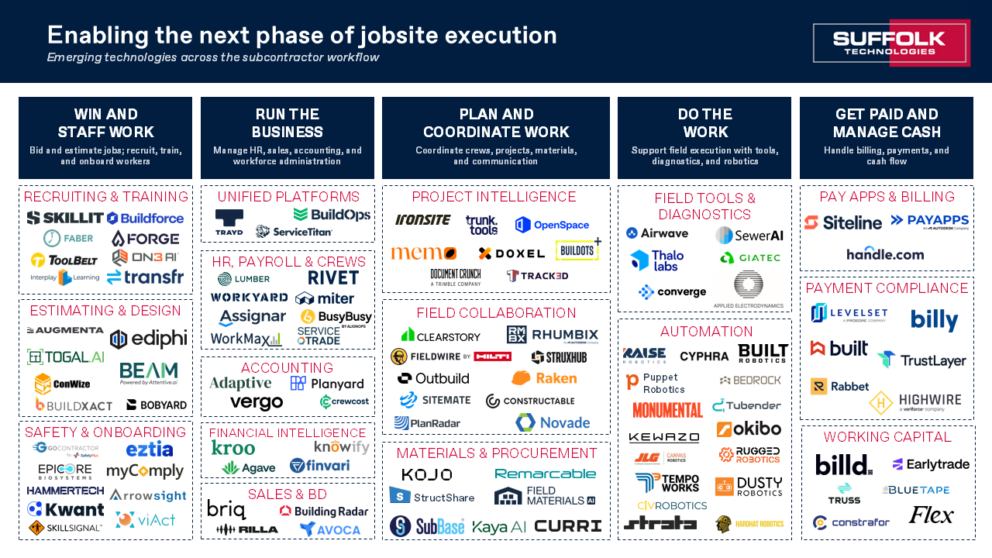
Technology has a significant opportunity to strengthen the construction workforce at every labor stage, from finding and managing labor to helping people work more safely, collaborate more effectively and keep projects financially healthy. When technology is designed around how construction works, it can help the industry make better use of its people, information and resources.
If you’re building in this space, don’t hesitate to reach out. And if you’re interested in sharing your adoption experience, come talk to us!
* indicates a Suffolk Technologies portfolio company.
Connect with Us
Join Ecosystem
Submit a Pitch
Innovation information for your job. Discover cutting-edge construction industry resources, companies, and projects through our monthly email newsletter.